How Long Did That Job Really Take? Using Time Sheets and Milestones Honestly
Every small business has a version of the same conversation. A customer asks for a price. Someone thinks back to a similar job, says "about six hours", and the quote goes out. Three weeks later the job is finished, and nobody is quite sure how long it took.
That is not carelessness. When the work is busy and the team is small, writing down time feels like paperwork for its own sake. But the cost shows up later, in quotes that are too low, weeks that feel longer than they should, and a nagging sense that some jobs pay and some do not, without knowing which.
This guide is about a small habit that fixes most of it: record the real time, compare it with the quote, and let the difference teach you something.
Start with what you already believe
Before changing anything, write down what you currently think. Pick the three kinds of job you do most often and put a typical time next to each. It does not need to be exact. It only needs to be written, because a belief that is written down can be tested, and one that lives in your head cannot.
Many teams find that the number they say out loud is the best case. It is the day when the materials arrived on time, the customer answered the first message and nothing had to be redone. That day does happen. It is just not the average.
Give every job a home
A job needs somewhere to live before its time can be measured. In Bindus, each client project has a title, a status and an owner. That sounds basic, and it is, but it settles two questions that cause most of the confusion: whose job is this, and is it still open?
Once a job has an owner and a status, the next step is to cut it into pieces you can recognise. Milestones do this inside a project. A milestone is a deadline or a marker of progress: the design is approved, the materials are ordered, the site visit is done. Three or four per job is usually plenty.
The point of milestones is not to impress a customer. It is to give the team a shared answer to "where are we?" that does not depend on who you ask.
Clock in, clock out
Time sheets in Bindus work on clock-in and clock-out, per person. When someone starts on a job they clock in, and when they stop they clock out. That is the whole routine.
A few habits make it work better than it sounds.
- Clock out when you stop, not at the end of the day. A memory of "roughly four hours this afternoon" is exactly the kind of guess you are trying to replace.
- Keep the job small enough to name. If every entry says "general work", the record tells you nothing. Tie time to the project it belongs to.
- Do not use it to watch people. The record is for quoting and planning. When a team feels watched, the numbers get tidied up, and tidy numbers are useless.
If the team understands that the goal is a better quote next time, and not a judgement on how fast anyone worked, they will usually record honestly.
Compare the quote with the clock
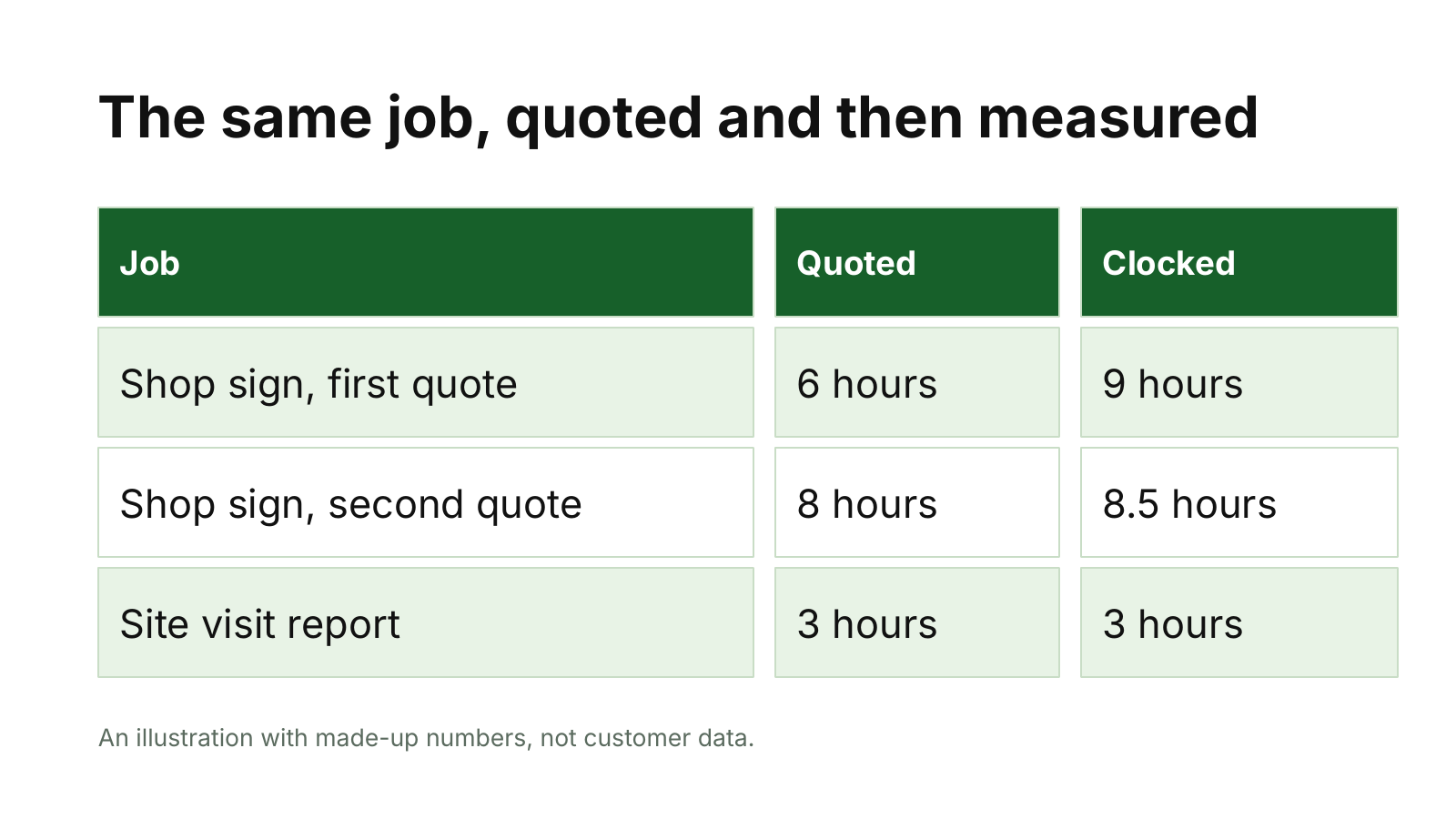
When a job closes, put the two numbers side by side: what you quoted and what was clocked. The table above uses made-up figures to show the idea. The first shop-sign job was quoted at six hours and took nine. The second, for a similar sign, was quoted at eight and took eight and a half.
Nobody was careless. The first quote was an optimistic guess. The second was adjusted using the first job's record, and it landed close. That small shift, from guessing to adjusting, is the entire benefit.
Look for patterns rather than single results. A job that overran once may have had a bad day. A kind of job that overruns every time is telling you the price is wrong, or that a step is being left out of the estimate.
Where the time went
When a job runs long, the milestones help you find out why. Compare the time clocked against each milestone and you can usually see where the extra hours collected. Perhaps the design stage took twice as long because the customer changed their mind twice. Perhaps the site visit was short but the travel was not counted.
Those are different problems with different fixes. One is a conversation about scope with the customer. The other is a line you forgot to put in the quote. Without the record, both look like "the job took longer than expected".
If you also track what comes in and goes out against each client and project, the picture gets sharper. Income and expenditure in Bindus can be linked to clients and projects, so a job that took a long time can be set beside what it earned and what it cost to deliver.
A sensible weekly rhythm
You do not need a big process. Try this for a month:
- At the start of the week, check that every open job has an owner and a status.
- During the week, clock in and out as work happens.
- When a job closes, spend five minutes comparing quoted and clocked time.
- Once a month, update the typical times you wrote down at the start.
Four steps, a few minutes each. After a month you will have a short list of jobs you under-quote, and probably one or two you over-quote.
If you want a wider routine to go with this one, our earlier guide on a 20-minute weekly review covers work, money, stock and people in one pass.
What this will not do
Time records will not tell you whether a job was worth doing. A long job for a good customer may be a fine investment, and a quick job for a difficult one may not be. They also will not fix an unclear brief. What they do is replace "I think" with "last time it was", which is a small change that makes every later decision a little easier.
Start with one job this week. Give it an owner, set a milestone, clock in, and see how close your guess was. Most people are surprised, and the surprise is where the improvement starts.